The Data Confirms What Great Fundraisers Already Know: Story Is Strategy
Every year, we set out to ask a simple but important question: what are donors actually telling us?
This year’s Giving Signals Report, Bloomerang’s 2026 survey of more than 1,000 active donors and 400 nonprofit fundraising leaders, gave us a lot to work with. The data is absolutely fascinating, and a few of the numbers genuinely surprised our team. What I found most interesting, however, is a theme that kept surfacing throughout the entire study.
Donors don’t just want to give. They want to feel something when they do.
Stories are our best tool to help donors feel connected to a person, an outcome, or a mission. They are the bridge between information and emotion.
The organizations that understand this, treating storytelling not as a nice-to-have but as core fundraising infrastructure, are the ones best positioned to grow.
In this article:
- The Biggest Insight: Trust Isn’t the Problem
- What Donors Are Actually Asking For
- Stories Should Answer the Donor’s Question
- Belonging Is Now a Fundraising Driver, Not Just a Feeling
- The Competitive Advantage Most Nonprofits Are Missing
- The Key Is Voice Capture, Not Just Story Collection
- One Story, Many Moments
- The Real Frame: Storytelling as Donor Confidence-Building
The Biggest Insight: Trust Isn’t the Problem
97% of recent donors agree that the nonprofits they interact with seem aligned with what they care about, 95% trust that the organizations they support use donor funds effectively, and nearly four in five donors trust nonprofits at large to use funds well.
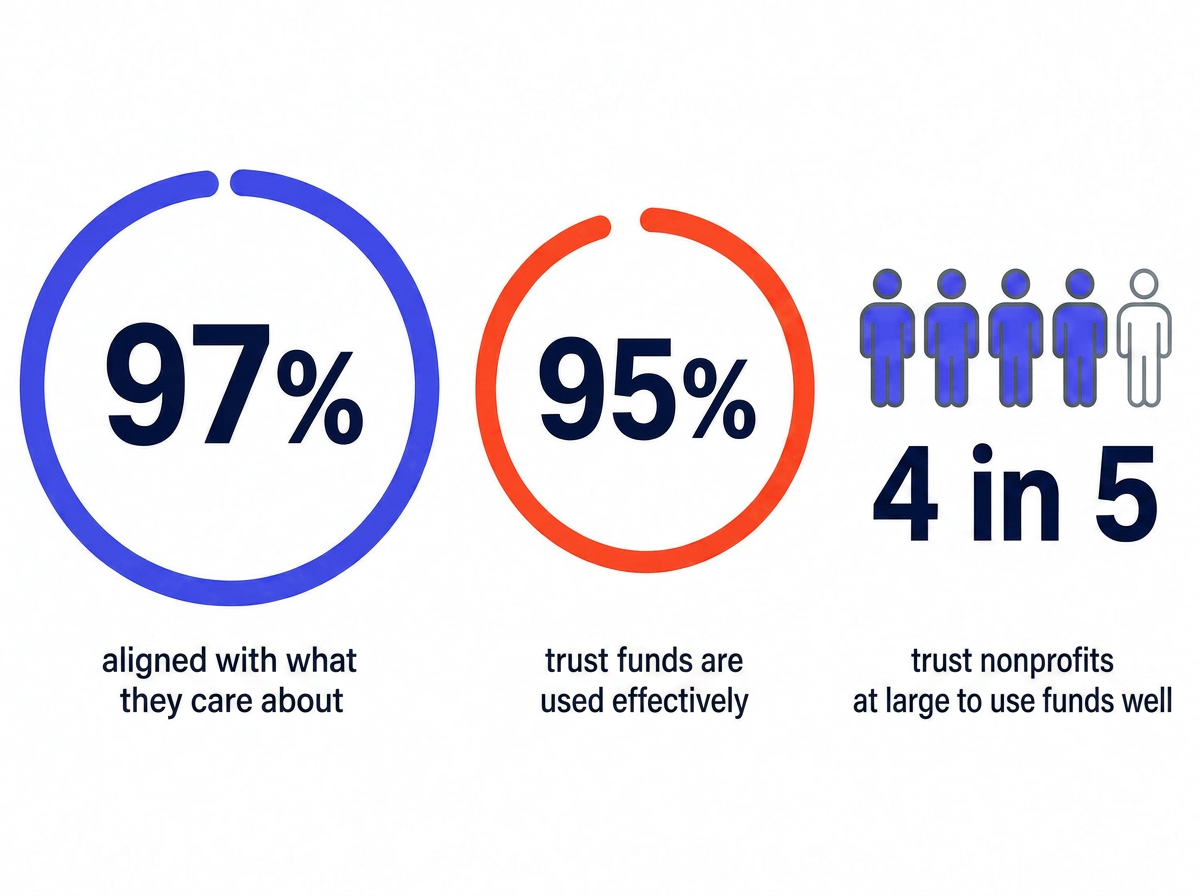
Many nonprofits still communicate as if the fundamental challenge is skepticism. As if donors need to be convinced that nonprofits matter, that the work is real, that they should care. But the data says something different. Donors already believe nonprofits matter. They already want to help. They already care deeply.
The issue is not belief. The issue is clarity, connection, relevance, and execution.
This distinction directly influences how you should approach storytelling. You are not fighting doubt. You are closing the distance between a donor who already wants to act and the evidence they need to feel confident doing it.
What Donors Are Actually Asking For
The report is clear on what moves donors from caring to giving. 94% say they’re motivated when an organization tells them exactly where their money will go. 90% say they’re motivated when told about the impact of their donation. Roughly half say beneficiary stories and testimonials are among the strongest signals that a nonprofit is effective, right alongside financial transparency and data.
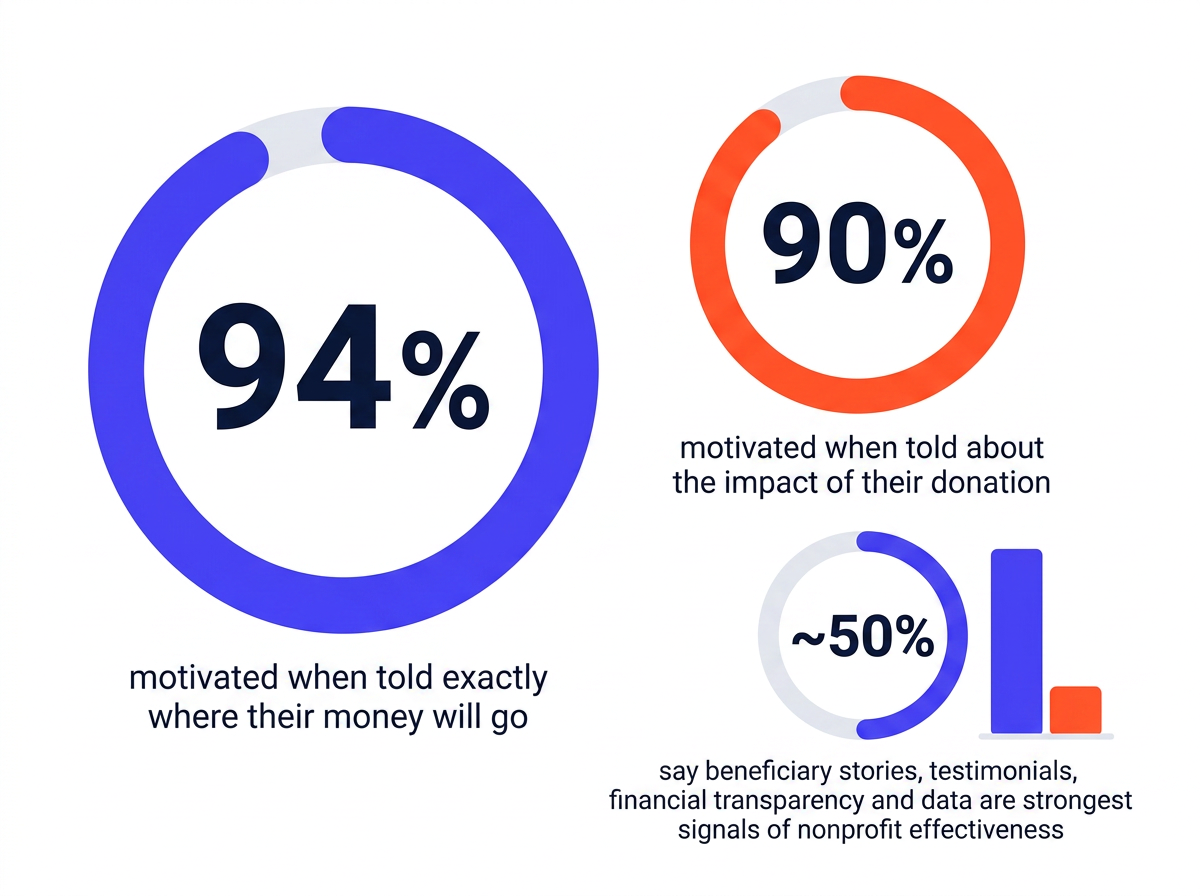
That last number is the one I keep coming back to. Donors want proof and humanity in the same communication… not one or the other.
This is what Natalie Monore, Community Engagement Manager at MemoryFox, calls the “Proof Plus Person” pairing, and it is a practical concept that is powerful in its simplicity and effectiveness in fundraising communicators right now. Every donor communication should contain one concrete impact metric and one authentic human story, not a giant emotional essay with no evidence. Not sterile statistics with no humanity. One number and one human, side by side.
The framework is simple: one stat, one story, one next step. It mirrors what the Giving Signals data tells us donors are looking for. It’s the kind of storytelling work that MemoryFox is built to support, collecting real voices, real photos, real videos, and real testimonials that can be tied directly to measurable outcomes.
Stories Should Answer the Donor’s Question
One of the clearest findings in the report is that donors want visibility. They want to know where their money went, who it helped, and whether it worked.
In practice, most nonprofit storytelling starts with the organization’s message, not the donor’s question.
A more useful approach may be to ask, before selecting or crafting any story: what donor question does this story answer?
Every story has a job. Some stories answer ‘did my gift matter?’ Others answer ‘who did this help?’ or ‘why should I trust this organization?’ or ‘am I part of something meaningful?’ Knowing which question a story answers before you share it is what separates intentional storytelling from content for content’s sake.
When you organize your storytelling around those questions, you stop creating content and start building donor confidence. That shift changes what you collect, what you share, and what donors do with it.
Belonging Is Now a Fundraising Driver, Not Just a Feeling
One of the most strategically significant findings in the report involves belonging, and it deserves more attention than it typically gets in fundraising conversations.
- 87% of donors say they’re motivated by nonprofits that make them feel like they’re part of something.
- For Millennials, that number climbs even higher, with 97% saying giving makes them feel like they’re part of something, compared to 87% for older generations.
- And for first-time donors specifically, feeling like part of something was selected as a top-three motivator by 46% of respondents, compared to just 28% of returning donors.
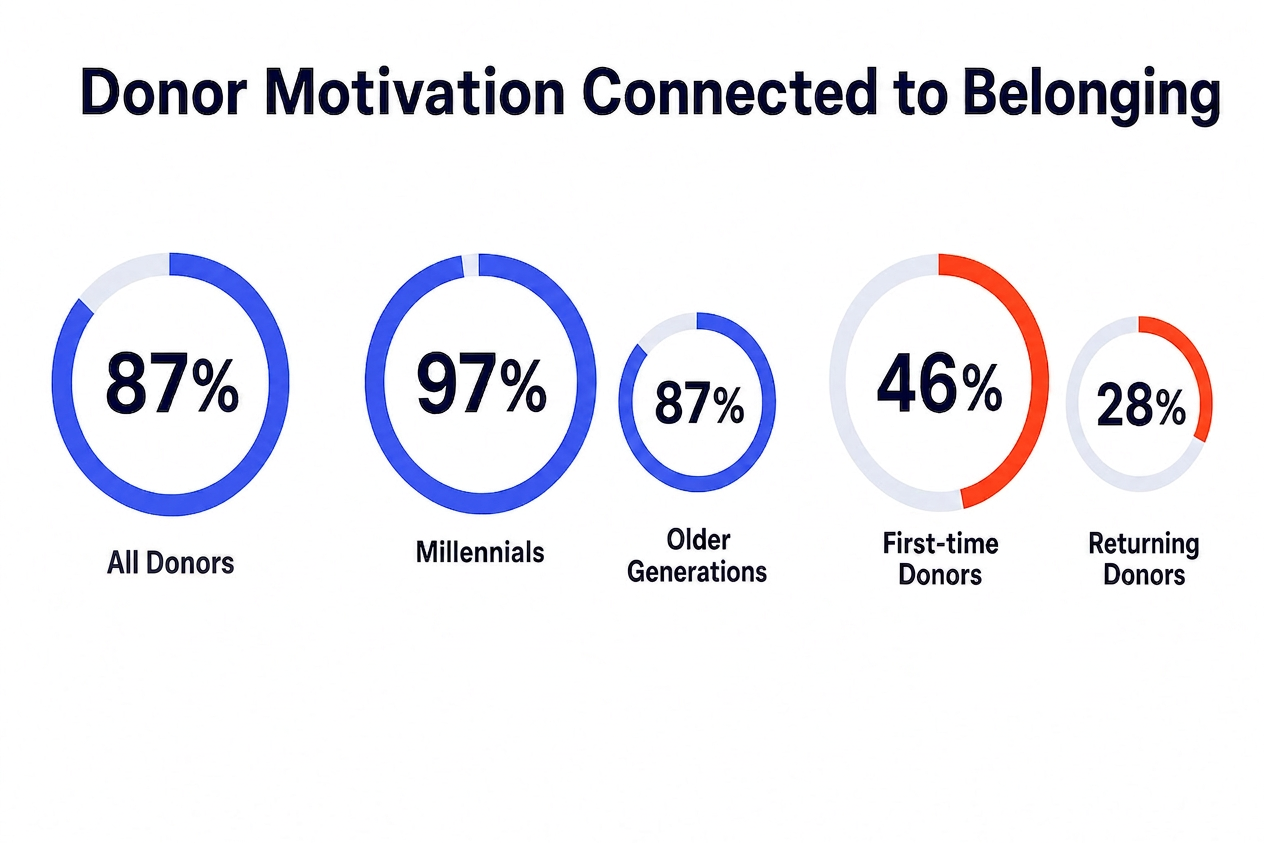
Belonging is how you acquire and keep donors, not just how you make them feel good.
What this means practically is that stories are identity-building tools, not just impact communication. When a donor receives an authentic story from your community, they are not just being informed about outcomes. They are being invited into a shared experience. They are being shown: people like me are involved here.
Ask this of every appeal, newsletter, and thank-you email: does this make the donor feel like an observer or a participant?
Community-generated content, the kind that comes directly from beneficiaries, volunteers, and long-term supporters, is uniquely powerful here because it naturally creates inclusion, participation, and social proof. This is one of the core reasons we built MemoryFox: to help nonprofits signal to their donors that – through stories – they’re part of a community, not just a cause someone else manages on their behalf.
The Competitive Advantage Most Nonprofits Are Missing
The Giving Signals report also points to a growing role for authenticity as a trust signal, especially for younger donors. Millennials are more likely than older generations to be influenced by third-party reviews, peer recommendations, and testimonials. They’re checking signals of legitimacy before they give, and the signals they find most compelling are human ones.
Consider these two versions of the same idea:
- Institutional voice: “Our workforce development initiative increased participant outcomes.”
- Human voice: “I finally felt like someone believed I could succeed.”
The second version is more believable, more memorable, more emotional, and more visual. It creates a mental image that a program description simply cannot convey.
Many nonprofit communications still sound like “here is what we did for them.” Authentic storytelling says “here is what they experienced.” That shift alone changes how donors trust you and whether they feel respected.
The practical move is straightforward: replace one polished institutional paragraph with one real human voice every time. Take the staff summary and ask, what would the participant say instead? Collect that. Share that. That is your most powerful asset.
The Key Is Voice Capture, Not Just Story Collection
Many organizations collect facts, summaries, and staff interpretations of participant experiences. What they don’t collect is actual participant language. That’s the version donors remember best.
You want the sentence only that person could say. The unexpected phrasing. The vivid detail. The emotional truth that comes from lived experience. True authenticity unshaped or manipulated.
Compare these two quotes:
- Generic: “The program helped me a lot.”
- Authentic: “For the first time in two years, my daughter slept through the night.”
The second quote is immediately more believable, more specific, more visual, and more memorable. It could only come from someone who lived it. That specificity is what creates donor trust, because it feels real and grounded in a way that polished summaries never do.
It’s also worth noting that polish can accidentally remove credibility. Donors aren’t looking for perfect grammar or corporate phrasing. They’re looking for emotional truth, specificity, and sincerity. A slightly imperfect real quote is often more trustworthy than a well-edited paraphrase.
This is why selfie videos work. They create eye contact, vulnerability, immediacy, and perceived honesty. A donor watching a participant speak directly into a phone often feels they are seeing a real person rather than “nonprofit content.” That feeling of watching a real person, not ‘nonprofit content,’ is the whole point.
One Story, Many Moments
The report also highlights the importance of channel fit, with email remaining the dominant communication channel across all generations and social media, text, and mobile carrying significantly more weight for younger donors.
For storytelling strategy, this has a practical implication worth building into your workflow: one story should not be a one-time artifact.
A single participant story, collected well, becomes an email snippet, a social reel, a donor quote graphic, an impact report feature, an event slide, a stewardship video, and a text campaign touchpoint. When you treat your story library as something to reuse, not just archive, each story you collect does a lot more work.
This is part of why MemoryFox is designed around collection, management, and sharing as three connected functions rather than separate tasks. The organizations getting the most from their storytelling aren’t just collecting more; they’re using what they have, consistently and intentionally, across every relevant moment in the donor journey.
The Real Frame: Storytelling as Donor Confidence-Building
I want to end with a reframe that I think has practical consequences for how nonprofits think about this work.
When storytelling is positioned primarily as marketing or content, it gets treated as a communications task. It competes for bandwidth with other communications tasks. It gets deprioritized when things get busy.
The Giving Signals data, however, makes a strong case for reconsidering this dynamic. Stories clarify impact. They reduce uncertainty. They increase transparency. They create belonging. They provide proof. They humanize outcomes. They do the exact work that donors have told us, repeatedly and clearly, that they need in order to give confidently and keep giving.
Authentic storytelling is, at its core, about reducing distance. The distance between donor and impact. Between organization and community. Between statistics and humanity. Between mission and lived experience. Every authentic story closes that distance a little more, and closing that distance is what builds the trust and belonging that keeps donors coming back.
The Giving Signals Report gave us a lot of data this year. The thing underneath all of it is something the best fundraisers in our sector already know. Generosity follows connection, and connection starts with a real human voice.
Ready to begin a storytelling plan that drives real connection?
Get our free 12-Month Storytelling Planner Worksheet:
—————————————————————-
The 2026 Giving Signals Report was conducted by The Harris Poll on behalf of Bloomerang, surveying 1,003 active donors and 405 nonprofit fundraising decision makers between March 13 and 24, 2026. Read the full report here.
Want to understand why storytelling is the connective tissue between donor motivation and donor action? Start here.
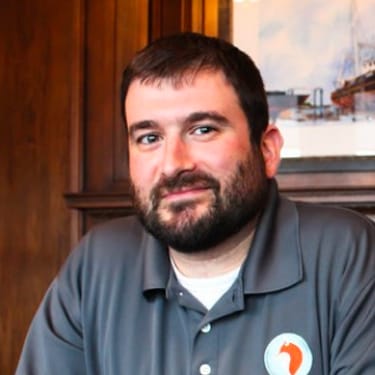
About the Author
Chris Miano
Founder and CEO, MemoryFox
Chris Miano was born and raised in Buffalo, NY. He spent eight years in the Army, traveling around the world and learning about the power of storytelling as a tool to connect with people across many cultures, generations, and socio-economic backgrounds.
When he returned home from Afghanistan, Chris thought about his grandfather, who was a WW2 veteran, and how cathartic it would have been to have him around to share stories with. This inspired Chris to create MemoryFox. The organization started as a way to capture the life story of his elder family members, and eventually grew to support mission-driven organizations.
Chris has made it his mission to elevate the stories of real human beings. He believes that through storytelling with grassroots community-generated content, the world can become a more inclusive and equitable place for everyone.